


Shaft Coupling

Coupling is a core component that transmits power and motion
from the driving shaft to the driven part while absorbing misalignment
and any possible factors that could reduce efficiency of machines
(e.g. vibration, noise, electric current, etc.)
SHD Series Go to SHD Series(Index)
Single Disk High Torque Disk Coupling
- Product Overview
-
Dimensions / Performance / CAD
Taper-ring
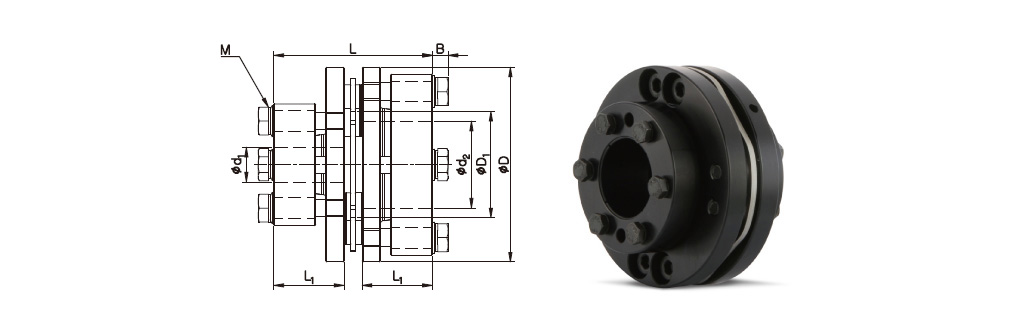
Dimensions / Performance
| Model | CAD | Size (±0.3mm) | Screw | Permissible Torque (N·m) |
Max. rpm (min-1) |
Moment of Inertia (kg·m2) |
Static Torsional Stiffness (N·m/rad) |
Mass (g) |
Permissible Misalignment | |||||||
|---|---|---|---|---|---|---|---|---|---|---|---|---|---|---|---|---|
| D | D1 | L | L1 | B | Size | Fastening Torque (N·m) |
Angular (˚) |
Parallel (mm) |
End- play (mm) |
|||||||
| SHDS-56T |  |
56 | 30.6 | 45.6 | 20.2 | 4.5 | M5 | 8 | 35 | 24,000 | 3.6×10⁻⁵ | 2.0×10⁴ | 190 | 0.7 | 0.02 | ±0.3 |
| SHDS-66T | |
66 | 35.6 | 57.5 | 25 | 5 | M6 | 13 | 60 | 20,000 | 8.6×10⁻⁵ | 3.0×10⁴ | 320 | 0.7 | 0.02 | ±0.3 |
| SHDS-88T | |
88 | 46 | 69.9 | 30 | 5 | M6 | 13 | 180 | 15,000 | 3.2×10⁻⁴ | 7.0×10⁴ | 670 | 0.7 | 0.02 | ±0.3 |
| SHDS-110T | |
108 | 60.5 | 70.1 | 30.7 | 5 | M6 | 13 | 280 | 12,000 | 1.6×10⁻³ | 1.4×10⁵ | 980 | 0.7 | 0.02 | ±0.5 |
- The Moment of Inertia and Mass values are based on products with max. Inner diameter.
- Due to the structure of Taper-ring, it’s not allowed to have other complementary options to enhance clamping force such as keyway etc. This is the reason why the above-mentioned permissible torques are based on the slip torque at the min. standard inner diameter. (The bigger inner diameter, the higher permissible torque.)
Standard Inner Diameter (ID)
| Model | Standard Inner Diameter (d1, d2) (mm) | ||||||||||||||||||||||||
|---|---|---|---|---|---|---|---|---|---|---|---|---|---|---|---|---|---|---|---|---|---|---|---|---|---|
| 10 | 11 | 12 | 14 | 15 | 16 | 18 | 19 | 20 | 22 | 24 | 25 | 26 | 28 | 30 | 32 | 35 | 38 | 40 | 42 | 45 | 48 | 50 | 55 | 60 | |
| SHDS-56T | ● | ● | ● | ● | ● | ● | ● | ● | ● | ● | ● | ● | |||||||||||||
| SHDS-66T | ● | ● | ● | ● | ● | ● | ● | ● | ● | ● | ● | ● | |||||||||||||
| SHDS-88T | ● | ● | ● | ● | ● | ● | ● | ● | ● | ● | ● | ● | ● | ||||||||||||
| SHDS-110T | ● | ● | ● | ● | ● | ● | ● | ● | ● | ● | ●★ | ||||||||||||||
- The recommended shaft tolerance is h7.
- Custom process (e.g. non-standard Inner diameter, special tolerance etc.) is also available upon a special request in prior to order placement.
- Keyway is NOT available
- Due to interference of the middle parts, make sure the shaft is only inserted into L1 depth for IDs with ★ mark. Consult us first if you’re concerned about misalignment.
Slip Torque
- The below table shows the actual permissible torque values when the slip torque value is lower than the coupling’s max. torque value.
- If the slip torque value is lower than the coupling’s max. torque value, please check and compare between the slip torque in the below table and the operating torque value of the connected motor. It is safer to size up the coupling or use a key/keyway when the slip torque value is lower than the motor’s operating torque.
- The below slip torque values may be subject to change according to different testing conditions. (e.g. shaft tolerance, surface roughness, surface treatment or acceleration/deceleration of driving shafts). On the other hand, the values could be affected when a different kind of fastening screw is used (body material or surface treatment). Therefore, we recommend you test under the same conditions before mounting.
| Model | Permissible Torque (N·m) |
Slip Torque (N·m) by Inner Diameter (d1, d2) | |||||||||||||||||
|---|---|---|---|---|---|---|---|---|---|---|---|---|---|---|---|---|---|---|---|
| 10 | 11 | 12 | 14 | 15 | 16 | 18 | 19 | 20 | 22 | 24 | 25 | 26 | 28 | 30 | 32 | 35 | |||
| SHDS-56T | 35 | ||||||||||||||||||
| SHDS-66T | 60 | ||||||||||||||||||
| SHDS-88T | 180 | 140 | 168 | 180 | |||||||||||||||
| SHDS-110T | 280 | 250 | 280 | ||||||||||||||||